Glossary
Customer service metrics that measure outcomes, not activity
Customer service metrics show you whether your support is keeping customers coming back. They're also what you plan automation around: you watch the numbers, then tune your playbooks and docs as your products change. This glossary and our KPI guide help you pick the ones worth tracking.

What to measure
Customer service metrics worth tracking
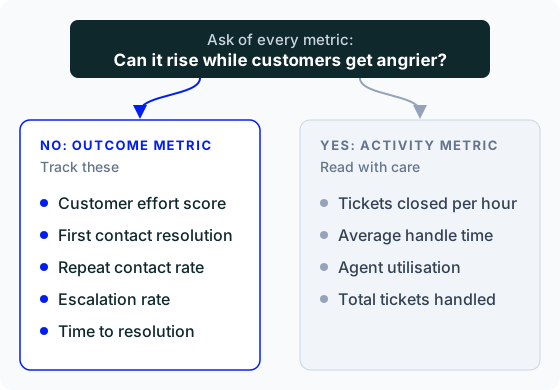
Each of these tells you something about the customer's experience. If you're only going to track five, pick them from here. Our KPI guide covers how to measure every one.
-
Customer effort score (CES)
How easy it was for the customer to get their problem sorted.
CEB's research found it predicts loyalty better than delight does. -
First contact resolution (FCR)
The share of issues fixed in one go. Only comparable if you pin down the time window and who gets to call it resolved.
-
Repeat contact rate
How often the same customer comes back about the same thing.
It catches the tickets marked resolved that weren't. -
Escalation rate
How often a conversation gets passed up a level.
Lower isn't always better... a team that never escalates is usually guessing. -
Containment rate
The share of conversations an AI agent finishes without a person stepping in.
Worthless if half of them come back. -
Time to resolution
How long until the problem's fixed. Use the median and split it by complexity, or one ugly ticket wrecks the average.
Read these with care
Tickets per hour, handle time and agent utilisation measure how busy your team is.
They look great in a report but say little about whether customers come back.
Here's why they mislead.
A to Z
Every term in the glossary
The words that turn up in your dashboards and in vendor demos, defined in plain language. Need the reply rather than the definition? Our refund and order reply templates are ready to copy.

Customer service metrics
-

-

-

-

-

Ecommerce operations
-

-

-

Support channels
-

-

-

-

One test
Help desk metrics, support metrics: same thing?
Pretty much. Help desk metrics usually means what your ticketing tool reports by default, mostly volume and speed. Our test for any of them: if the number can rise while customers get angrier, it's an activity metric, and it belongs below the outcome ones.
Automation you can measure and keep tuning
Hay.chat's dashboard tracks your resolution rate and every escalation, so you can see which playbooks and docs to adjust as your products change.
- 30-day free trial
- No credit card required
- Hosted in Europe
 30-day free trial