Customer service metrics
First contact resolution: how to measure FCR honestly, and fix more issues in one go
First contact resolution (FCR) is the share of customer issues sorted on the first contact, with no follow-up needed. It only compares fairly between teams that use the same time window.
How to calculate FCR#
FCR = issues sorted on the first contact ÷ eligible issues × 100.
Say you had 1,000 issues last month, and 150 of them couldn't have been fixed in one contact whatever you did (a backorder, say, or a bug waiting on engineering). That leaves 850 eligible. If 600 of those were sorted first time, and the customer didn't come back about the same thing within seven days, your FCR is 71%.
Pin down the definition#
Nobody measures FCR the same way, and that's why teams argue about it so much. Some teams count an issue as resolved when an agent closes the ticket, while others wait for the customer to confirm. Some check for repeat contact over 24 hours, others over seven days. An 85% on one definition and a 70% on another can describe the same team.
So pick yours and write it down. We'd use seven days and no repeat contact about the same issue, and leave out the issues nobody could fix in one go. Then compare yourself with yourself.
What's a good FCR rate?#
SQM Group's benchmark, which uses a seven-day window, puts the average at around 70%, with retail and ecommerce higher at 78%. Above 80% is rare. Treat those as a sanity check rather than a target, because the comparison only works if your definition matches theirs.
What keeps FCR low#
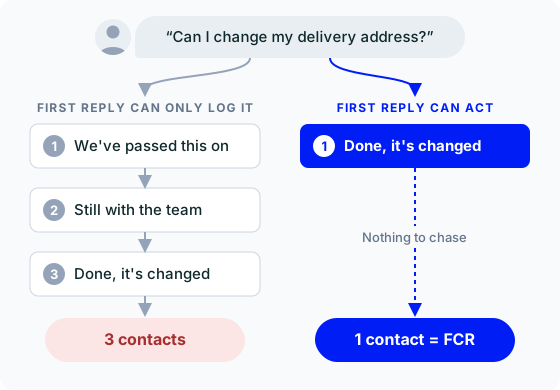
Usually it's authority. The first person (or bot) the customer reaches can see the problem but can't fix it, because they can't change the address, approve the refund or even see the order. So they log it and promise someone will be in touch, and that's a second contact before anything's been done.
How Hay.chat raises FCR#
Hay.chat connects to your store, so the first reply can do the job instead of logging it. It can look up the order, change the address, cancel it, or issue a refund when your playbook calls the case clear-cut. That's the gap between "we've passed this on" and "done, it's changed".
When it can't settle something, it hands over inside the same conversation with everything attached, so the customer doesn't have to get in touch again. Hay.chat's dashboard reports resolution rate rather than FCR, so track repeat contacts alongside it. Our guide to customer service KPIs covers how.
 30-day free trial