Customer service metrics
Customer effort score: how to calculate CES, and why easy beats delightful
Customer effort score (CES) measures how easy it was for a customer to get their issue sorted, usually with one survey question sent after the conversation. It predicts loyalty better than satisfaction scores do.
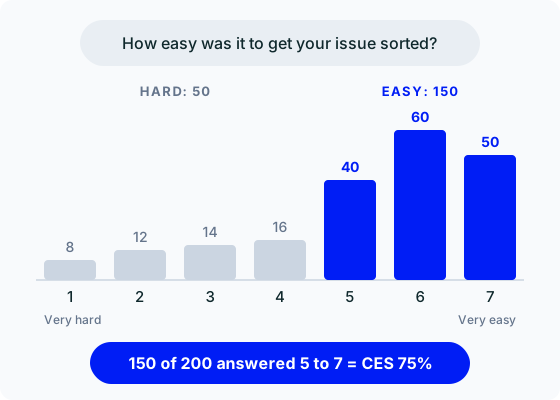
What is a CES score?#
It's the answer to one question, asked straight after an interaction: "[Your company] made it easy to handle my issue." Customers answer from 1 (strongly disagree) to 7 (strongly agree). Some teams use a 1 to 5 scale, or ask "How easy was it to get your issue resolved?" instead. Either works. Just don't switch halfway through the year, because scores on different scales don't compare.
The metric came out of CEB research (CEB is now part of Gartner), published in Harvard Business Review in 2010 as "Stop Trying to Delight Your Customers". The headline finding: 96% of customers who had a high-effort experience became more disloyal, against 9% of those who found it easy.
Customer effort score calculation#
The usual method is a percentage: count the responses of 5, 6 or 7, divide by all responses, and multiply by 100. If 150 of 200 customers answered 5 or higher, your CES is 75%.
Some teams average the scores instead and report something like 5.4 out of 7. We wouldn't. An average of 5.4 can hide the one customer in five who answered 1 or 2... and those are the ones about to leave.
Why easy beats delightful#
A handwritten note in the box is lovely, but it won't save a customer whose last problem took three emails and a phone call to fix. That's the whole point of CEB's 96% figure.
Effort is also relative to what the customer expected. Thirty minutes setting up new software feels fine, while ten minutes finding out where a parcel is feels like a wasted afternoon, so compare CES within one type of issue rather than across your whole queue.
What drags your CES down#
Usually a handoff. The customer gets asked for an order number they already gave, or moves from chat to email and has to start the story again. Pull your lowest-scoring conversations and read them, and you'll find the same moment over and over.
How Hay.chat cuts customer effort#
Hay.chat doesn't send CES surveys, so run those from your helpdesk or email tool. What it does is cut the steps that push effort up. With your store connected, it looks the order up itself instead of asking the customer for details you already have. And when it hands a conversation to your team, the person who takes over sees the whole thread (plus that customer's previous conversations on their profile), so nobody asks them to start again.
Then watch your CES alongside the escalations on Hay.chat's dashboard. If effort rises on one topic, the fix is usually a missing doc or a playbook that needs another step. Our guide to customer service KPIs covers where CES sits next to the other metrics.
 30-day free trial