Customer service metrics
Ticket deflection vs resolution: cut your ticket volume without leaving customers stuck
Ticket deflection is when a customer gets an answer from self-service (a help article, chatbot or tracking page) instead of opening a ticket. It lowers volume, but doesn't prove anyone's problem got solved.
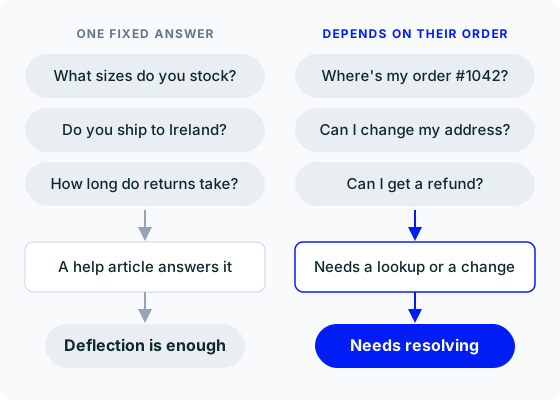
What is ticket deflection?#
A customer has a question and, instead of emailing you, finds the answer on their own: a help centre article, an FAQ, a chatbot reply, a tracking page. The ticket never reaches your team, so it counts as "deflected".
You'll also hear it called case deflection, mostly in B2B support and Salesforce setups, where a ticket is called a case.
Deflection rate formula#
Deflection rate = self-service users who didn't open a ticket ÷ all self-service users × 100.
If 2,000 people used your help centre or chatbot last month and 1,500 of them never contacted your team, your deflection rate is 75%.
The tricky part is the 1,500. You're counting something that didn't happen, and "didn't open a ticket" covers the customer who found the answer, but also the one who gave up, left a one-star review, or quietly cancelled the order. The formula can't tell them apart.
Deflection vs resolution#
That blind spot is why we don't treat deflection as the goal. It only tells you the customer didn't reach you, while resolution tells you their problem's gone.
Send a tracking link to someone whose parcel is a week late and it counts as deflected, even though nothing's been fixed. They'll be back tomorrow on a different channel, and now you've got the ticket you were trying to avoid, plus an annoyed customer. (Our WISMO page has the long version.)
When deflection works#
For questions with one fixed answer, deflection is exactly right. Sizing, opening hours, which countries you ship to: nobody wants to wait in a queue for that, and a good article answers it for everyone.
It stops working once the answer depends on the customer's own order or account, because an article can't look anything up. That's where most help centres plateau, and our post on why FAQ pages don't reduce tickets goes into why.
What Hay.chat does instead#
Hay.chat answers the fixed-answer questions from your docs, like any decent help centre would. The difference is the rest of the queue. With your store connected, it looks up the order, updates an address, or issues a refund when your playbook says the case is clear-cut, so the conversation ends with the problem gone rather than a link to read. The full list is on the actions page.
So judge it by the resolution rate on Hay.chat's dashboard, not by how many tickets it kept away from your team. And if you're comparing AI vendors, ask which of those two numbers they're quoting.
 30-day free trial