Why Your HubSpot CRM Integration Only Pays Off When AI Can Use It


HubSpot CRM integration is one of those things companies treat as a checkbox. Connect the tools, sync the contacts, move on. But what integration is worth has changed. When AI can see everything a customer's done with you in one place, it does things fragmented tools physically can't. And most e-commerce teams are still running fragmented stacks.
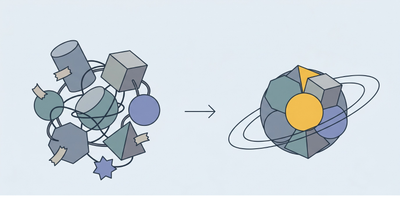
A CRM here. A marketing tool there. Support in a third platform, payments in a fourth. Each tool has its own silo of customer data, and each tool's AI features can only work with the data they can see. Your marketing AI can't factor in a support complaint filed yesterday. Your support AI doesn't know the customer is mid-deal with sales.
Feature comparison pages skip right past this.
HubSpot CRM integration matters most when your AI tools can reach the full picture, because that's what compound learning depends on.
The Real Cost of a Fragmented Stack#
Most companies calculate the cost of their tool stack by adding up subscription fees. That's the visible number. The expensive part is what fragmentation prevents.
| What you budget for | What fragmentation costs |
|---|---|
| Subscription fees per tool | Engineers maintaining custom integrations (39% of developer time, per MuleSoft) |
| Annual licence renewals | Staff paid to make the tools talk (one Reddit example: ~$3M/year in integration salaries, one team, not an average) |
| Per-seat add-ons | The compound learning you never get: five tools that each know 20% of the customer |
| Nothing (you never line-item it) | Blind spots you've quietly accepted as normal |
The subscription fee is the line you see. The second column is the one that hurts.
MuleSoft's 2025 Connectivity Benchmark Report found that 39% of developer time goes to building and maintaining custom integrations rather than building product. Its 2026 report puts the share of enterprise applications that are connected at just 27%. For mid-market e-commerce, that means the engineering team you hired to build competitive advantage is instead maintaining duct tape between your tools. Expensive duct tape.
One practitioner on Reddit reported spending $4.2M in annual SaaS licence fees alongside $3M in salaries just for integration and maintenance staff. That's one person's example, not an industry average. But the pattern is common enough to be recognisable. When your tools don't talk to each other natively, you pay people to make them talk. And when they still don't talk well enough, you accept blind spots.
The concept practitioners keep circling back to is "compound learning." AI in your marketing tool can't see CRM data. AI in your CRM can't see the product roadmap. AI in your support platform can't see purchase history unless someone built a custom integration that probably breaks every time one vendor updates their API.
Each tool gets smarter in isolation but never gets smarter about your customer. You end up with five tools that each know 20% of the story.
Every Monday morning at e-commerce companies running fragmented stacks, the same thing happens. Your support team handled 300 conversations over the weekend. Refunds processed, shipping addresses updated, complaints logged, product questions answered. How much of that information made it into HubSpot? If you're relying on manual logging, the honest answer is: very little. Your CRM shows a customer with no recent activity, while your support tool shows the same customer filed three tickets last week. Your sales team sees a clean contact record and sends a marketing email. The customer, already frustrated, gets even more frustrated.
And the hidden cost of switching CRMs to fix this? The licence fee is the smallest part. Re-training your team and cleaning up data takes months. People stay on bad setups because migration feels worse than the status quo, and that inertia compounds the fragmentation problem every quarter it goes unaddressed.
Why HubSpot Keeps Winning Mid-Market E-Commerce#
HubSpot reports 258,258 paying customers across 135+ countries as of early 2025, with subscription revenue hitting $2.57B in 2024. Self-reported numbers. But the trajectory tells a story.
HubSpot keeps winning mid-market deals because it prioritises fast execution over bespoke governance. Salesforce partisans will happily tell you it's more powerful. They're probably right. But power you can't deploy quickly is theoretical power, and e-commerce companies doing €2M-€8M don't have six months to spend on CRM implementation.

| Metric | HubSpot Self-Reported Figure | Caveat |
|---|---|---|
| Positive ROI at 12 months | 95% | Vendor survey |
| "Easy to use" rating | 92% | Vendor survey |
| Report increased revenue | 84% | Vendor survey |
| Report increased productivity | 89% | Vendor survey |
Source: HubSpot ROI page, aggregated by XtendedView and Hublead. All self-reported vendor data.
Vendor surveys about vendor products always look good. But the consistency of the "easy to use" signal across independent forums and review sites suggests it's more than marketing spin. The growing sentiment in practitioner communities on r/CRM and r/SaaS is straightforward: if you need to move fast, HubSpot gets out of your way.
BruntWork, a remote outsourcing company, moved from Salesforce to HubSpot specifically because of what they called the prohibitively high "cost of acquisition" on Salesforce. The total cost of getting the platform to do what they needed, not the licence fee itself. After switching, they expanded to 14+ countries with HubSpot tracking full customer lifecycle from keyword performance to lifetime value. If you've been through a CRM migration (or talked yourself out of one because the switching cost felt too steep), that story probably sounds familiar.
The comparison that matters for CRM costs is always total cost of ownership: implementation time, training burden, integration maintenance, and the opportunity cost of features you can't use because they're too complex to set up.
What Breeze AI Changes About the Equation#
HubSpot's embedded AI layer, Breeze, demonstrates what native AI can do that bolt-on AI can't.
Most AI tools sit on top of a CRM, accessing data through APIs with whatever limitations those APIs impose. Breeze is built into HubSpot's Smart CRM across marketing, sales, and service hubs. It has access to the full customer record by default.
That distinction matters for practical reasons. When AI can see the whole picture, it can auto-update lead scoring based on support interactions, not just marketing engagement. It can trigger personalised nurture sequences without manual intervention. It can connect a support complaint to a sales opportunity without someone copying and pasting between tabs.
Some early results from companies using Breeze Customer Agent (from HubSpot's case study library, so selection bias applies):
-
XanderGlasses: immediate response times for common customer questions
-
Lepermislibre: 94% of conversations resolved without human intervention
-
Hostelworld: projects 40-50% decrease in response times with multilingual support
The 94% resolution rate from Lepermislibre is striking. But it raises a question that the case study doesn't answer: what happens with the other 6%?
This is where Breeze's scope becomes relevant. Bain & Company research (reported by CX Dive) found that customers will accept an unfavourable outcome from a human but not from a bot. The human escalation path matters as much as the automation rate.
And there's a prerequisite that often gets overlooked. The IBM Institute for Business Value found that 49% of executives cite data inaccuracies and bias as the primary barrier to adopting agentic AI. Breeze sidesteps part of this problem by sitting inside HubSpot's own data layer. But for e-commerce teams whose customer data lives across Stripe, Shopify, and a support platform, Breeze is only as good as what's been synced into HubSpot. Native AI on incomplete data still produces incomplete results.
Breeze handles CRM-native actions well: updating records, scoring leads, triggering workflows. But for e-commerce-specific actions (processing refunds through Stripe, looking up order status in Shopify, modifying subscriptions), it's working through connectors rather than native integrations. For teams already deep in the HubSpot ecosystem, that's worth understanding before assuming Breeze handles everything.
| Bolt-on AI (sits on top via API) | Native AI (Breeze, inside Smart CRM) | The gap that remains | |
|---|---|---|---|
| Sees the full customer journey | Only what the API exposes | Yes, by default | Only if the data was synced into HubSpot |
| CRM-native actions (lead scoring, workflows) | Limited | Strong | None |
| E-commerce actions (Stripe refunds, Shopify orders) | Varies by connector | Through connectors, not native | Where the duct tape comes back |
Native beats bolt-on on data access. Neither one fixes data that never reached HubSpot in the first place.
Two Companies That Stopped Duct-Taping Their Stack#
Case studies from vendors come with a marketing sheen. But the before-and-after patterns here match what you hear in forums and Slack channels constantly, so they're worth examining.
Clearwing is a live event production company. Before HubSpot, they ran campaigns across Mailchimp, Asana, Hootsuite, Eventbrite, SurveyMonkey, and Google Sheets. Reporting was manual. Attribution was anecdotal. ("We think that campaign worked because... we got more leads around that time?")
After centralising on Marketing Hub, campaign build time dropped from weeks to days. For their AVL Expo event specifically, they tracked 250+ leads, $8M+ in revenue, 100+ sales influenced, with a calculated 4,200% ROI. That result is for one event, not general platform performance. But the shift from "we think it worked" to "we can measure exactly what worked" is the real story. The revenue was a consequence of finally being able to see what was happening.
BruntWork is the Salesforce-to-HubSpot migration story mentioned earlier. The detail worth noting: they switched because HubSpot was easier to set up, handled growing complexity without proportional cost increases, and let new team members get productive quickly. When you're expanding to 14+ countries, easy onboarding functions as a multiplier on everything else.
Both companies had the same underlying problem. Too many tools, each requiring its own integration, its own maintenance, its own learning curve. The consolidation payoff wasn't one dramatic improvement. It was the removal of friction across dozens of daily workflows.
Where HubSpot Integration Still Falls Short#
It would be dishonest to write about HubSpot CRM integration without acknowledging where it breaks.
Home service companies and agencies have been vocal about the lack of native integration between Google Local Services Ads (LSAs) and HubSpot. LSAs are a major lead source for local companies, and the data doesn't flow into HubSpot cleanly. These aren't niche edge cases; they're core revenue channels for entire verticals.
The workarounds (Zapier, custom webhooks) lose or flatten critical booking data, creating attribution blind spots. You know you got a lead. You don't know which keyword, which ad variation, which time of day. Teams end up adding bridge tools like Hatch or LeadTruffle, which adds cost and creates vendor lock-in on top of the integration problem they were trying to solve.
Every platform has gaps. HubSpot's are less visible because the core integrations (email, forms, website, major ad platforms) work well. But when you hit an edge case, you're back to duct tape. If your business depends heavily on a channel that HubSpot doesn't integrate with natively, test that specific integration during your trial. Don't assume it works because everything else does.
What Happens When AI Can See Your Whole CRM#
When AI tools operate on a fragmented stack, each one automates its own slice. Your marketing AI optimises email sends. Your support AI suggests responses. Your CRM AI scores leads. None of them see what the others are doing.
Say a customer files an angry support ticket on Saturday. On Monday, your marketing automation sends them an email asking if they'd like to upgrade. The lead score hasn't changed because the support tool and the CRM don't share data in real time. Your sales team sees a clean contact record. Meanwhile, the customer is drafting a tweet about how tone-deaf your company is.
When AI operates on a unified CRM, those disconnects disappear. A support conversation where a customer mentions a competitor triggers a sales alert. A refund request pauses a marketing sequence. A pattern of support tickets from customers on a specific plan surfaces for product review.
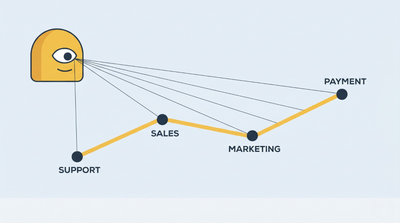
Hay is built to be the support layer that keeps HubSpot current. Many teams already use HubSpot for sales and marketing; Hay handles support automation alongside it rather than replacing it. When Hay connects to HubSpot, every customer conversation updates the CRM automatically. Refund processed through Stripe? Logged to the HubSpot contact timeline with order details, reason, and a tag for follow-up analysis. Customer mentions they've changed companies? Contact record updated in real time. Support issue needs escalation? Ticket created in HubSpot with full conversation context attached.
The difference from manual logging comes down to completeness. When humans log CRM updates, they're selective. They log what seems important and skip the rest. When AI handles it, everything gets recorded. Your CRM reflects what's happening with customers, not what someone remembered to type in after the conversation ended.
And because Hay reads HubSpot data too (deal stages, custom properties, previous interactions), it personalises responses based on full customer context. A customer in an active trial gets a different tone than someone who's been paying for two years. That's compound learning in practice: support data informs sales context, sales context informs support responses, and the quality of every metric you're tracking improves because the underlying data is complete.
The Question Worth Asking Before You Integrate Anything#
Most companies evaluating a HubSpot CRM integration ask "does it connect?" The better question: "what can our AI do with the data once it's connected?"
If the answer is "each tool still only sees its own silo," you've added a connector without solving the underlying problem. If AI can see the full customer journey, act on it, and feed learnings back into the CRM, you've built something that improves over time.
That's the actual ROI of integration: the intelligence that becomes possible because of it.
Hay connects to HubSpot in minutes and starts at €50/month. Your first 30 days are free, onboarding support included. Start your free trial and see what your support data looks like once it reaches your CRM.
Ask AI about this page
