Helpdesk Automation: Three Strategies, One Most Teams Miss.

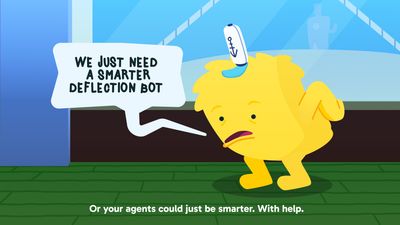
Helpdesk automation has a dirty secret that vendors would rather you didn't think about too carefully: when it fails, it makes things worse. Actively worse. A customer who gets bounced between a chatbot and a confused agent doesn't just leave unsatisfied. They leave pre-frustrated, having wasted ten minutes explaining a problem to a machine that didn't understand them, only to start from scratch with a human. Average handling time goes up. CSAT goes down. And the comparison point isn't "with automation vs. without automation." It's "with bad automation vs. if the customer had just reached a person in the first place."
That's the broken loop. It's the number that never appears in vendor ROI calculators, and it should be the first thing you think about before automating anything.
TL;DR: Helpdesk automation covers three distinct strategies: triage (routing the right issue to the right person), deflection (resolving simple queries without human involvement), and agent assist (AI coaching your team in real time). Most teams stop at the first two. The third, agent assist, is where AI makes your existing team faster and sharper, rather than trying to replace them. It's also the strategy most likely to avoid the broken loop entirely, because it keeps humans in the conversation.
Three Strategies, One Label#
When someone says "helpdesk automation," they could mean any one of three things. The problem is that most implementations blur them together, and that confusion is where things start to go wrong.
Triage#
AI categorises incoming requests by topic, sentiment, urgency, and language, then routes them to the right team. This replaces the round-robin assignment that most help desks default to. Instead of every agent getting a random mix of refund requests, WISMO queries, and order modifications, triage ensures the agent best equipped for a specific issue type gets it first.
Triage is the least glamorous form of automation. It doesn't resolve anything on its own. But it reduces misrouting, which is one of the biggest hidden time sinks in e-commerce support. Every misrouted ticket means a handoff. Every handoff means context gets lost. Every lost context means the customer repeats themselves. You've seen this play out if you've ever looked at your ticket data and noticed the same customer appearing three times in a day for what should have been a single interaction.
Deflection#
This is what most people picture when they hear "helpdesk automation." A chatbot or self-service flow resolves simple, repetitive queries without a human ever touching the ticket. WISMO. Returns eligibility. Shipping timeframes. Refund status. The kind of queries that have one correct answer and don't require judgement.
Deflection gets the most attention because the ROI story is straightforward. If, say, 40% of your tickets are "where's my order?" and you can automate that with live tracking data, you've freed up significant capacity. The maths is compelling. But if your FAQ page already covers these topics and tickets keep coming anyway, that's a sign the problem runs deeper than what deflection alone can fix. (Worth reading: why your FAQ page might not be reducing tickets the way you expected.)
Agent Assist#
This is the one most teams skip. Agent assist means AI provides real-time prompts, suggested responses, and knowledge base links to human agents during live conversations. The agent runs the conversation. The AI acts as a copilot, surfacing the customer's order history, the applicable return window, the recommended resolution, all without the agent having to search for it.
The practical effect: a junior agent with six weeks of experience performs at the level of someone with two years on the team. The AI surfaces the relevant context; the agent handles the judgement call and the human relationship. Nobody needs to memorise your entire product catalogue or remember that you changed the returns policy last Tuesday.
| Strategy | What it does | Best for | Risk if done badly |
|---|---|---|---|
| Triage | Routes tickets by topic, sentiment, urgency | Reducing misrouting; matching agents to their strengths | Over-categorisation creates bottlenecks |
| Deflection | Resolves simple queries without human involvement | High-volume, single-answer queries (WISMO, refund status) | The broken loop: failed deflection creates pre-frustrated customers |
| Agent Assist | Gives agents real-time AI suggestions during conversations | Complex issues, new agent ramp-up, policy-heavy queries | Over-reliance on suggestions; agents stop thinking critically |
The Broken Loop (And Why Bad Automation Is Worse Than None)#
Here's the scenario. A customer contacts your store because they were charged twice for an order. The chatbot asks them to describe their issue. They type "double charged." The bot interprets this as a billing enquiry and surfaces your generic payment FAQ. The customer tries again: "I was charged twice for order #4871." The bot asks for their email. They provide it. The bot can't look up the order because it has no connection to your payment system. It suggests they "contact support." They're already contacting support.
By the time a human agent picks up the conversation (if the handoff even works), the customer has spent five minutes getting nowhere. They're annoyed. The agent has to de-escalate before they can solve the actual problem, which takes longer than if the customer had reached a human straight away. If you've ever managed agents through this kind of interaction, you know the toll it takes; it's a big part of why de-escalation skills matter so much in modern support teams.
This is the broken loop, and it's consistent across multiple industry analyses (Chanl.ai, Operative Intelligence, Bain & Company via CX Dive). Failed chatbot interactions don't just fail to resolve. They actively increase handling time and decrease satisfaction compared to direct human contact. Bad automation is a net negative, and that's the number most ROI models conveniently leave out.
Hay was designed specifically to avoid this. Hay uses a confidence threshold you set, 75% by default: when it isn't sure about an answer, it routes to a human with the full conversation history and a summary of what was attempted. The customer never has to repeat themselves. The agent picks up mid-conversation with complete context. It's not a perfect system (nothing is), but it prevents the scenario where a bot guesses wrong and the customer pays the price.
What Your Customers Actually Expect#
There's a persistent assumption that customers prefer self-service over talking to people. The data tells a more complicated story, and the companies paying attention to it are seeing dramatically different results.
Bain & Company's research (via CX Dive, studying US banking customers) identified what the industry calls the "tolerance gap": customers will accept an unfavourable outcome from a human agent. They won't accept one from a bot. The tolerance for "no" is completely different depending on who delivers it. For simple tasks like checking a balance, digital channels scored well (49-72 out of 100). For anything requiring judgement or empathy, customers want a human. Full stop.
Fewer than 2 in 5 consumers are confident in AI self-service as a support tool (per the same Bain study). And the number one frustration? Difficulty explaining their issue. Not slow responses. The fundamental inability to make themselves understood.
The tolerance gap has measurable financial consequences. Forrester's Total Economic Impact study of Zendesk (2025, based on interviews with 8 decision-makers across 7 organisations) modelled a composite company of 225 agents within a 3,000-employee B2B and B2C operation. The implementation that delivered 301% ROI over three years, with payback in under six months, was built around Zendesk's AI copilot: surfacing insights, recommending next steps, and executing approved actions while keeping human agents in the conversation. Faster handle times. Better agent productivity. The human never leaves.
That's a revenue argument for keeping humans in the loop. The teams delivering triple-digit returns are the ones treating AI as an agent's tool, not the customer's obstacle course.
So what do customers actually expect? Speed on the simple stuff. Humans on the hard stuff. And behind the scenes, AI that makes those humans faster rather than trying to make them unnecessary.
Why Most Helpdesk AI Projects Fail#
MIT's Project NANDA study ("The GenAI Divide," 2025) analysed over 300 public AI deployments and surveyed 153+ senior leaders. Of the 60% of organisations that evaluated enterprise AI systems, only 20% reached pilot stage. Of those, only 5% reached production with measurable P&L impact. That's a 95% failure rate for enterprise AI pilots, set against $30-40 billion in cumulative investment.
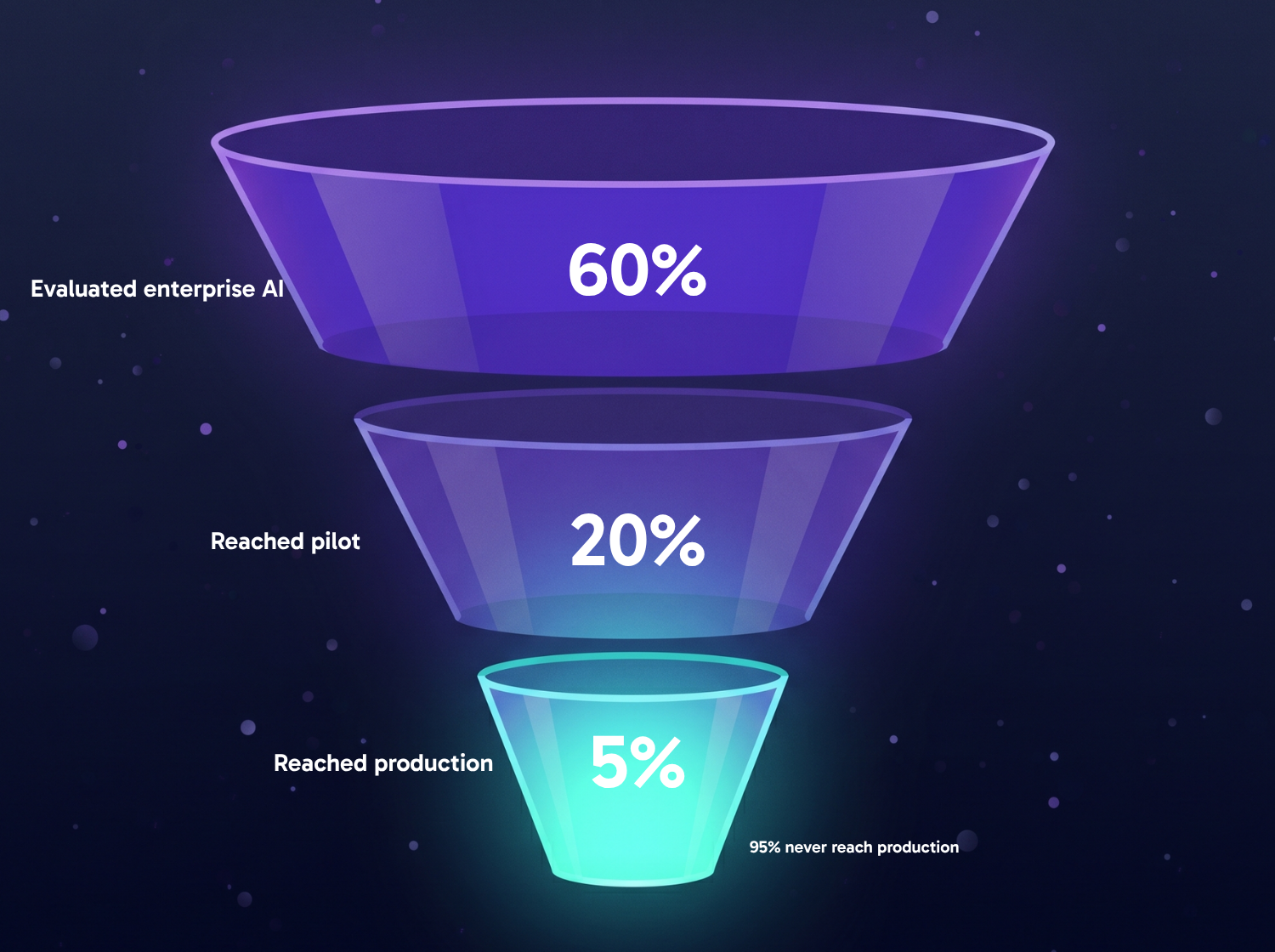
The root cause is instructive: businesses automate against their own internal categories rather than against actual customer-stated needs.
In e-commerce support, this plays out in a specific way. Your internal ticketing system has categories like "billing," "shipping," "returns," and "product." But customers don't think in those categories. They write "I got the wrong colour and the box was damaged and I need this sorted before my daughter's birthday on Saturday." That's three categories and an urgency signal in one message. If your automation is built around how you organise information, rather than how your customers describe their problems, the first interaction already feels like a mismatch.
The failure pattern has a few consistent ingredients:
Stale training data#
Most chatbots train on historical tickets and knowledge base articles. Those tickets reflect last quarter's product catalogue, last quarter's policies, last quarter's shipping partners. When you switch from DPD to Evri, or change your returns window from 30 days to 14, the chatbot doesn't know until someone updates the training data. Nobody budgets for ongoing training data maintenance because the vendor made it sound like a one-time setup.
Sanitised training data#
Support tickets get cleaned before they become training data. Spelling gets fixed. Slang gets standardised. Emotional language gets stripped. The result is a chatbot trained on polished English that can't understand how real customers write. "This is broken I want my money back rn" doesn't pattern-match to the neatly formatted training examples.
Reasoning gaps on multi-step problems#
AI excels at pattern matching. It's genuinely poor at logical reasoning across multiple conditional steps. A customer who ordered two items and wants to return one while exchanging the other for a different size is making a request that feels simple to a human but requires multiple dependent actions that most chatbot architectures handle badly. The customer gets a generic returns flow. They get frustrated. They call.
This is avoidable. The 95% failure rate reflects implementation quality, not a technology ceiling. One finding from the same MIT study worth noting: vendor-built tools succeed roughly 67% of the time, while internal builds succeed only about 33%. The researchers attribute the gap to what they call the "learning gap." Most AI systems don't retain feedback or adapt to context over time. The ones that do are disproportionately the ones making it to production.
The Everboarding Effect#
Traditional onboarding in support teams is a phase. You hire someone, train them for a few weeks, hand them a login, and from that point they're learning on the job. Which means they're learning through mistakes. Which means your customers are the training ground.
There's a well-documented reason this model fails. Research dating back to Hermann Ebbinghaus in 1885 (and replicated as recently as 2015) shows that people forget roughly 50% of new information within 24 hours and up to 90% within a month if it isn't reinforced. Modern research adds nuance: practical, job-relevant content holds better than abstract training material. But it still decays significantly without active reinforcement. Your three-week onboarding programme is fighting biology.
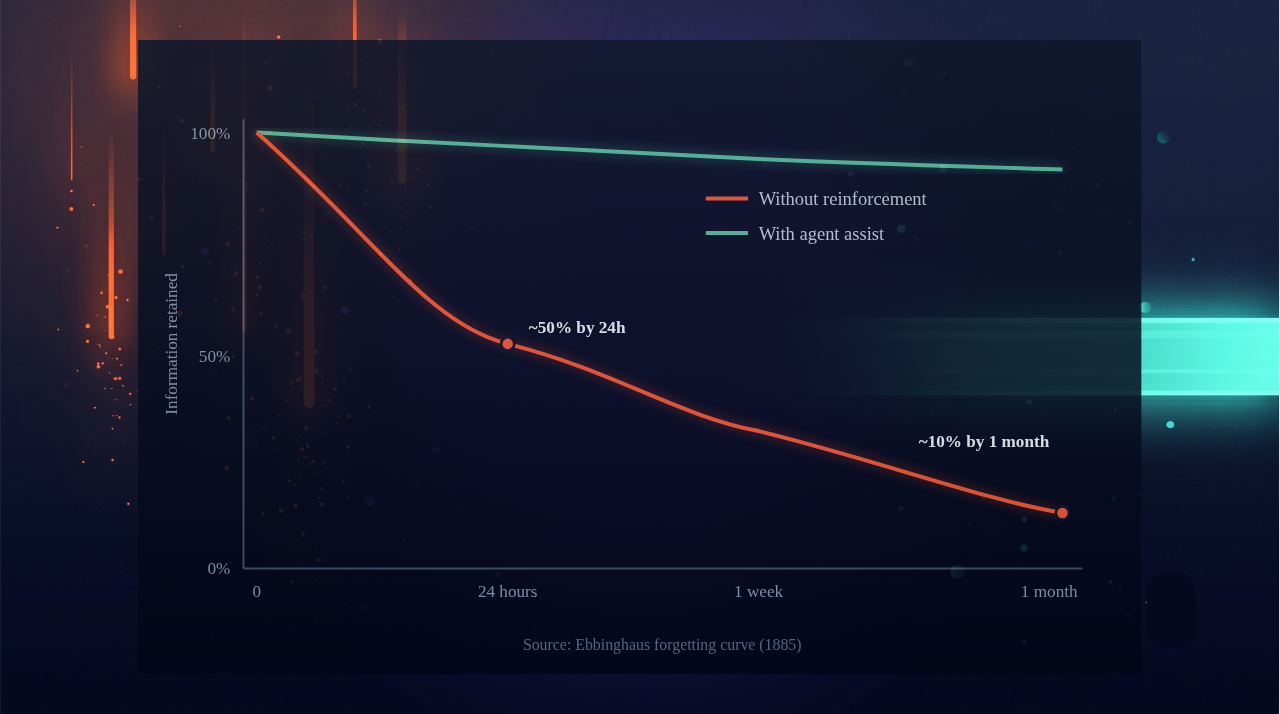
Agent assist rewrites this model. The industry term is "everboarding" (per CX Today and Apizee), and it describes what happens when AI provides ongoing, real-time coaching during every conversation. Instead of expecting agents to recall classroom training weeks later, the system delivers information exactly when they need it, during a live interaction.
Picture a Tuesday morning. Your newest agent picks up a ticket from a customer who wants to return an item they bought eight weeks ago. Your standard return window is 30 days. But this customer has spent over £2,000 with you in the past year, and they've never made a return before. A senior agent would know to make an exception. Your new hire wouldn't; they'd quote the policy and lose a loyal customer. With agent assist, the AI surfaces the customer's lifetime value, their purchase history, and the recommended resolution (approve the exception, flag for review) before the agent has finished reading the ticket. The new hire makes the same call the senior agent would have.
That's the promise, and when it works, the downstream effects compound. Forrester's TEI study of Microsoft 365 Copilot for SMBs (composite: 200 employees, $35M revenue) found a 25% acceleration in new-hire onboarding, directly tied to AI-led access to information and automated administrative support. The same study reported a 20% reduction in employee attrition and an 18% increase in employee satisfaction, attributed to eliminating the repetitive, draining tasks that burn agents out fastest.
For larger teams, Forrester's enterprise study (composite: 25,000 employees) measured average time savings of 9 hours per month per user. That's roughly 2.7 workweeks per year of reclaimed productivity, from spending less time searching for information and more time using it.
The knowledge gap shrinks#
The senior agent's advantage has always been institutional memory: the edge cases, the exceptions, the "technically the policy says X but we always do Y for high-value customers" decisions. Agent assist makes that knowledge available to everyone. Every agent sees the same context, the same decision history, the same customer signals.
Multilingual support becomes practical#
Real-time translation means a team of English-speaking agents can handle queries in French, German, or Spanish without hiring native speakers for every market. The AI translates. The agent handles the judgement and the relationship.
Agent burnout finds a pressure valve#
A significant source of agent stress is the feeling of not knowing the answer while a customer waits. Fumbling through a knowledge base, switching between tabs, hoping the article you found is still current. Agent assist removes that friction. The agent always has context. They can focus on the human side of the conversation instead of the information retrieval side.
The framing here matters. Most helpdesk automation conversations centre on doing more with fewer people. Everboarding is about making the same people significantly better at their jobs. It tends to land differently with teams who are (understandably) nervous about automation replacing them.
Getting the Implementation Right#
If you're implementing helpdesk automation or fixing one that isn't working, here's what consistently matters.
Map your issues before you pick a tool. List every type of request your team handles. Rank by volume and complexity. Identify which genuinely suit automation (high volume, low complexity, single correct answer) and which need humans. Most teams skip this and go straight to "which chatbot platform should we buy?"
Connect to your system of record. Your automation needs real-time access to your order management system, your CRM, your billing platform. Without live data, the bot can't tell a customer their actual order status, can't verify their account, can't process a refund. It becomes a fancier FAQ that happens to live in a chat window.
Hay connects natively to HubSpot, Stripe, WooCommerce, and Zendesk, reading from and writing back to each. When it resolves a conversation, it updates the contact record, logs the transaction, and creates follow-up tickets. Every conversation makes the next one better because the context is captured, not lost.
Disclose AI upfront. Be honest that the customer is talking to a bot. "You're chatting with our AI assistant. I can help with most questions, and I can connect you with a person anytime." Trying to pass AI off as human backfires the moment the illusion breaks, and it always breaks.
Make the human escalation path visible from message one. Not buried three menus deep. Not available only after the bot has failed twice. A permanent, obvious option. Remember the tolerance gap: customers accept a "no" from a human, but they won't accept one from a bot (Bain & Company via CX Dive, 2025). If the human option isn't visible, you're losing customers.
Transfer full conversation history on handoff. When a customer moves from bot to human, the agent should see everything: the original question, the bot's attempts, the customer's sentiment. The customer never repeats themselves. This is the most common failure point in helpdesk automation, and it's entirely a design choice.
Track the metrics that actually matter. AI resolution rate is useful, but it's one number. Also track morning backlog change (is the queue smaller when your team arrives?), escalation rate broken down by reason, and CSAT on AI-handled vs. human-handled conversations separately. For a fuller framework on which metrics predict real outcomes, there's a deeper guide on customer service KPIs that actually predict churn.
Where Helpdesks Are Heading#
This section comes with a caveat: what follows is industry direction, not established fact.
Support operations are starting to shift from pure cost centres towards something with revenue potential. The logic is straightforward. A customer contacting support about a product they bought is, by definition, engaged. AI that can spot a cross-sell opportunity during that interaction (recommending a complementary product while resolving the original issue) turns a support cost into a revenue event. CX Today and Apizee both point to this as an emerging trend, and the early implementations look promising. But it's early. It's happening in pockets. Don't let a vendor sell you this as a proven model yet.
The more grounded prediction: helpdesk automation will increasingly be measured by resolution quality rather than deflection volume. The teams building for that standard (connected to real customer data, designed around how customers actually communicate, with escalation paths that treat humans as the feature) are the ones building something durable.
Automation that makes your team better is worth investing in. Automation that walls off your customers from the help they need will cost you more than it saves. The difference between the two is usually implementation, and it's almost always fixable.
Hay handles triage, deflection, and agent assist across one platform, with native connections to HubSpot, Stripe, WooCommerce, and Zendesk. Start a free trial and test it against your actual ticket volume. No commitment, no credit card.
Ask AI about this page
